GeM Portal Products Price List and How Rates Work
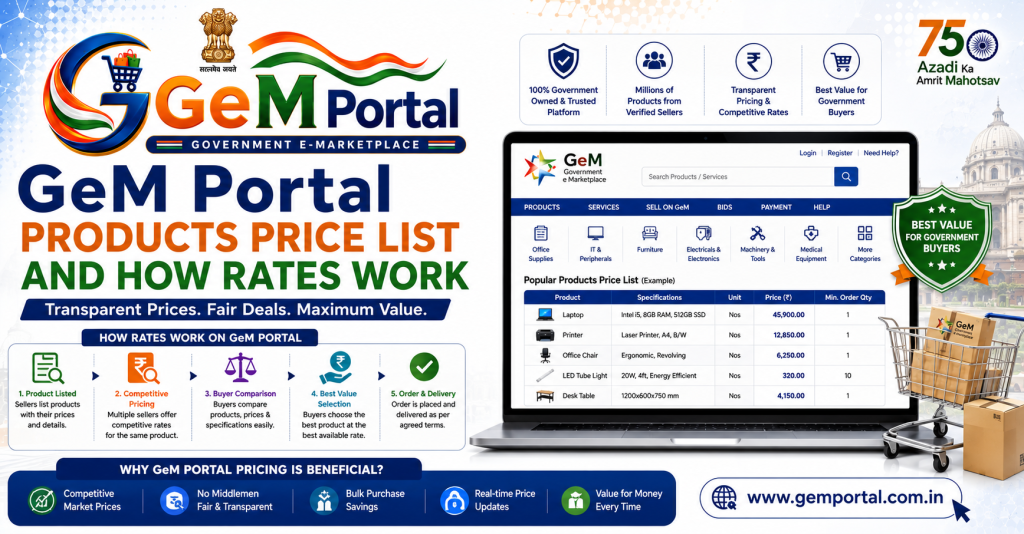
People search for a GeM portal products price list expecting a rate chart, and there is not one. GeM does not fix prices. Sellers set their own, revise them when costs change, and compete against each other, which means the price of a chair on GeM today is not the price next month. What does exist is a reliable way to check current rates for any item in about a minute, and that is what this page shows you, along with how pricing actually works for buyers and sellers.
Nobody can sell you a GeM rate list. gemportal.com.in/ publishes no price file and charges nothing. Prices live on gem.gov.in and change daily.
Why there is no fixed GeM portal products price list
GeM is a marketplace, not a rate contract system. The old DGS&D model published rates and departments bought against them. GeM replaced that with live competition, which is the entire reason it exists. Three things follow from that.
- Two sellers can list the same item at different prices on the same day.
- The price you see includes what that seller decided to charge for delivery, warranty and installation, so a low unit price is not always the cheaper offer.
- Prices move. Raw material costs, exchange rates and competition all push them.
How to check the GeM portal products price list in a minute
- Search the catalogue for the item by its plain name using the method on our product list page.
- Filter to the exact specification you need, since a different memory size or a different warranty term is a different price.
- Sort by price and read at least five listings, not one.
- Check the delivery period and the consignee location, because both change the real cost.
- For larger purchases, look at recent bid results in the same category to see what buyers actually paid rather than what sellers are asking.
Buyers, note the difference. Catalogue price is what a seller asks. Contract price is what a bid or comparison settled on. For budgeting, past contract prices in your own category are far more useful than catalogue prices.
How sellers should price against the GeM portal products price list
Work backwards from the floor, not forwards from the market
Start with your cost, add freight to the likely consignee states, add warranty and installation cost, add the transaction charge that applies above the contract threshold, then add the cost of waiting for payment. What is left is your real margin. The charge structure is explained on our fees page.
Price for the purchase route you expect
Direct purchase and comparison reward being visible and competitive in the catalogue. Bids and reverse auctions reward having room to move. If your category goes to reverse auction often, a catalogue price with no margin leaves you nothing to bid with, which the strategy section of our tender guide covers.
Update prices deliberately
Stale prices lose orders quietly. Nobody tells you that a buyer picked someone else. Review your listings monthly, and check them whenever input costs move.
Why the same item shows different prices on the GeM portal products price list
- Different specification hidden behind a similar name.
- Delivery included in one price and not another.
- Different warranty periods.
- Installation and commissioning bundled or excluded.
- One seller is an OEM and another is a reseller with a margin on top.
- Stock position, which makes some sellers price to avoid orders they cannot fulfil.
How buyers justify a price without a GeM portal products price list
Officers still have to satisfy audit, and they do it with the records the platform generates rather than with a published rate. In a direct purchase the officer records the listing chosen. In a comparison the system stores the offers compared. In a bid the whole evaluation sits in the file. That trail is the justification, which is why the platform was built this way in the first place, as explained on our what is GeM portal guide.
For budgeting before a purchase, officers usually look at what similar departments recently paid rather than at catalogue asking prices. Past bid results are more useful than any list because they show settled prices with delivery included.
Reading a listed price properly
| Check | Why it changes the real cost |
|---|---|
| Exact specification | One parameter difference can explain a large gap |
| Delivery included or extra | Freight to a district can exceed the discount |
| Warranty period | One year against three is a different product commercially |
| Installation and commissioning | Excluded installation becomes your problem later |
| Delivery period offered | A cheap price with a 45 day delivery may miss your deadline |
| Seller rating and history | A failed supply costs more than the saving |
Why prices in the same category vary through the year
Government buying is seasonal. Demand rises before financial year end when budgets must be used, and sellers price accordingly. Input costs move with commodity prices and exchange rates. Competition changes as new sellers enter a category. None of this is visible in a static price list, which is the deeper reason no useful one can exist. For sellers, the practical response is to review listed prices monthly and to keep enough margin for the reverse auctions described on our tender guide.
Frequently asked questions
Where can I download the GeM portal products price list?
There is no official downloadable price list. Prices are live in the catalogue on gem.gov.in.
Does GeM control the prices in the products price list?
No. Sellers set their own prices. GeM makes comparison easy, which is what pushes prices down.
Are GeM prices cheaper than the open market?
Often, because of competition and volume, though not always once delivery and warranty terms are compared properly.
Can a seller change a price after listing?
Yes, subject to restrictions during an active bid. Regular updates are expected.
How do buyers justify a price to audit?
Through comparison records and bid documents generated by the platform, which is part of why the process is explained on our what is GeM portal page.
Is GST included in the listed price?
Check the listing, because treatment varies by category and seller. The contract will state it clearly.