GeM Vendor Assessment: A Complete Seller Guide
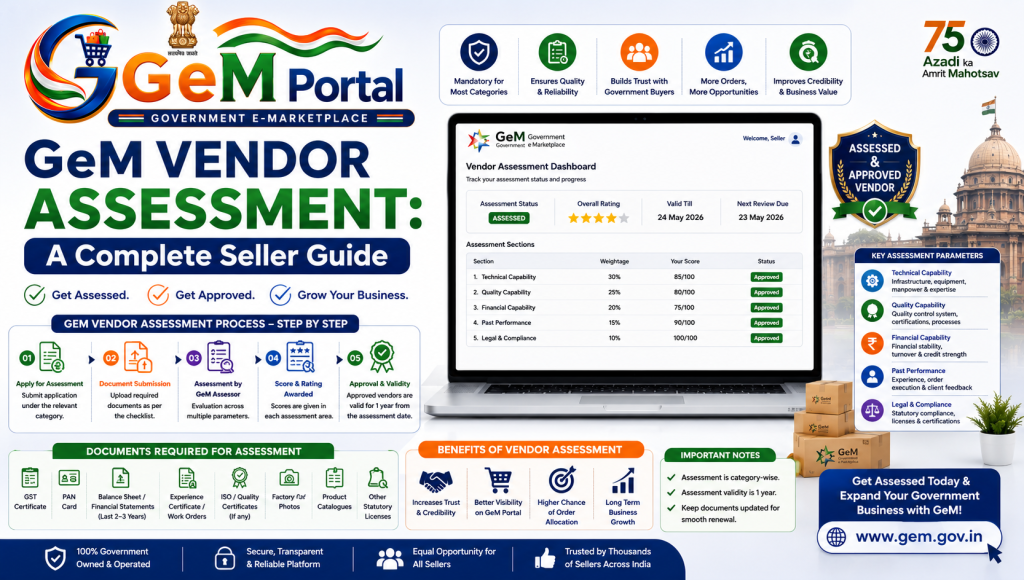
GeM vendor assessment is a third party check of whether a seller can actually supply what they are listing. It applies mainly to manufacturers and sellers registering as OEMs, it carries a fee, it has a validity period, and it is the step that catches most new sellers by surprise because nothing during registration warns them it is coming. This page explains who needs it, what the assessor looks at, how to prepare so that one visit is enough, and which sellers are exempt.
We do not conduct or arrange assessments. gemportal.com.in/ is an independent guide. Vendor assessment is booked and paid for inside your own account on gem.gov.in.
Who needs GeM vendor assessment
- Sellers registering as OEMs or manufacturers in categories where the platform requires it.
- Sellers wanting to list in certain product categories regardless of manufacturer status.
- Sellers whose category or contract value crosses defined limits.
Pure resellers and traders in many categories do not need it, but they do need OEM authorisation instead, which is a different document with its own delays and is covered on our documents required page. Check the requirement for your specific category on the portal before you assume either way.
What GeM vendor assessment actually examines
Legal and financial standing
Registration certificates, PAN, GST, audited financials where applicable, and whether the entity on paper matches the entity operating.
Infrastructure
Premises, machinery, production or storage capacity, and whether it is consistent with what you claim to supply.
Quality process
Testing arrangements, certifications relevant to the category, inspection records and how rejects are handled.
Delivery capability
Manpower, past supply records and whether you can meet the delivery periods typical in your category.
How the GeM vendor assessment process runs
- Apply for assessment from inside your seller account and pay the applicable fee.
- Upload the document set requested.
- An assessment agency schedules a visit or a remote review depending on the category.
- The assessment is carried out and observations are recorded.
- The result is applied to your account, unlocking the listing rights it covers.
- The assessment stays valid for a defined period, after which it needs renewal.
Prepare once, pass once. A failed or incomplete assessment costs you the fee and the weeks it takes to rebook. Have every record printed and indexed before the assessor arrives, and make sure the person who knows your production process is present that day rather than travelling.
What it costs and how long it lasts
The fee and the validity period are published on the official portal and are revised from time to time, so take the current figures from there rather than from any article. Treat it as a business cost like a certification renewal: predictable, plannable, and worth budgeting for if your category needs it. The wider cost picture for sellers, including caution money and transaction charges, is on our GeM fees page.
GeM vendor assessment preparation checklist
- Incorporation or registration certificate, PAN, GST.
- Latest audited financial statements or returns.
- Factory or premises documents, rent agreement or ownership proof.
- List of machinery with purchase invoices.
- Quality certifications relevant to your category, such as BIS or ISO where applicable.
- Past purchase orders and dispatch records.
- Manpower details and any statutory registrations such as EPF and ESI.
- Test reports for the products you intend to list.
What happens if you skip GeM vendor assessment
Nothing dramatic, and that is the problem. Your account keeps working, but listings in the affected categories stay restricted and bid options may not appear. Sellers spend weeks assuming something is broken, when the dashboard was telling them all along, in the same way that expired certificates hide options as described on our login and access guide.
OEM, reseller or trader: the decision that triggers assessment
GeM treats these three differently, and choosing wrongly at registration is what lands sellers in an assessment they did not plan for, or blocks them from a category they could have sold in.
OEM or manufacturer
You make the product. You get to list it under your own brand, you can authorise resellers, and in many categories you go through vendor assessment.
Authorised reseller
You sell someone else’s brand with their written authorisation. Usually no assessment, but the authorisation letter becomes a document you must keep current, and losing it mid tender is a common failure described on our documents page.
Trader
You buy and sell without a brand relationship. The narrowest position, since many categories restrict who can list.
Decide what you actually are before registering, not after, because changing it later means new documents and sometimes a fresh assessment. The organisation and category choices are covered step by step on our registration guide.
What a weak assessment usually looks like
Assessments rarely fail on capability. They fail on evidence. The machinery exists but the purchase invoices are missing. Production happens but no inspection records are kept. Staff are employed but statutory registrations are not current. The assessor is checking whether your paperwork matches your operation, so the preparation task is mostly clerical.
A week of filing beats a rebooking. Print everything, index it, and walk your own premises with the checklist before the assessor does. Gaps are cheap to fix in advance and expensive to fix afterwards.
After assessment: what it does and does not unlock
A completed GeM vendor assessment removes a restriction on listing in the categories it covers. It does not make buyers choose you, it does not exempt you from bid eligibility conditions, and it does not replace product certifications that a category demands. Sellers sometimes expect orders to follow immediately and are disappointed. What follows is the ability to compete, and competing well still depends on your catalogue quality and price, which our pricing page covers.
Diarise the renewal date the day your assessment is approved. When it lapses, listings quietly restrict again, and the seller is usually the last to notice.
Frequently asked questions
Is GeM vendor assessment mandatory for all sellers?
No. It depends on your category and whether you are registering as a manufacturer or OEM.
How much does GeM vendor assessment cost?
The current fee is published on the official portal. It is a one time charge for a defined validity period.
Who carries out the assessment?
An assessment agency engaged for the purpose, not the buyer and not GeM staff directly.
How long does it take?
Usually weeks rather than days, mostly spent scheduling and preparing records.
Can a trader avoid assessment by listing as a reseller?
Sometimes, but then OEM authorisation becomes necessary and your margin structure changes. Decide based on what you actually are, using the guidance on our registration page.
Does assessment guarantee orders?
No. It removes a restriction. Winning orders still depends on your catalogue, price and delivery record, which our product listing guide covers.